ARCS Model Comic Strip

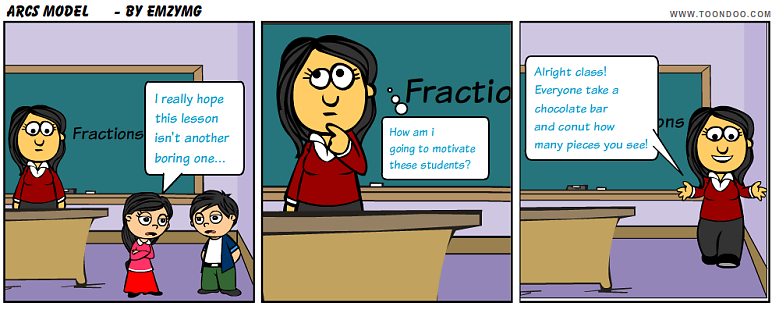
When creating my comic strip about the ARCS Model of Motivation, I wanted it to be something that introduces the model as a whole. Since the first step in the model is “Attention” I wanted my comic to revolve around that. The comic depicts a teacher overhearing two students discussing their disinterest in past lessons, and possibly the upcoming one. The teacher gets to thinking about what she can do to get the students motivated about fractions. In the end, she comes up with the idea to use chocolate bars as a model for fractions, to pique their interest with an object they like.

Having never used an online comic creator before, I think ToonDoo was a very simple tool. It did not take long for me to understand the mechanics and what everything does. However, unless I need to make a comic for another assignment in the future, or possibly use it in my classroom someday, I probably won’t use it again.

I think the usage of comics in the classroom is a fun way to get students attention. There are many ways to make them humorous and connect to what you want them to learn at the same time. I know that while I was in school, there was a teacher of mine who loved to used comics to convey a point that connected to our lesson, and it helped give new insight on the topic.

ARCS Model of Motivation

This weeks module reading was based around John Kellers ARCS Model of Motivation, a theory designed to help promote motivation in students during the learning process. These four processes outlined by Keller are “Attention, Relevance, Confidence, and Satisfaction”. For this post, I am to answer certain questions about the reading so I will post them here for a better context:

  1. Describe a part of this week’s readings that surprised you and explain why.
  2. Explain which aspects of the ARCS module you feel most – and least – comfortable with.
  3. What do you consider the main ideas of this week’s lesson? Why

From all of the readings on the ARCS Model, I would have to say that the popular use of the game Minecraft in the classroom is the most surprising. There is normally the thought that video games are distracting to students in a learning environment so I wouldn’t think that I would hear of such a popular game being embraced so easily. After reading about the ways the game is being used as a teaching tool such as demonstrating historical landmarks and storytelling, it makes sense to me just how successful this could be. By engaging students in learning through a media that already interests them out of the classroom, the “attention” stage of the model is easily achieved, motivating the students to learn.

In regards to which aspect of the model I feel most comfortable with, I would have to answer with the Attention stage. There are so many innovative ways to peak interest in a lesson with students. Anticipatory sets are the first thing that introduces students to a topic with the use of hands-on activities, fun but informational videos, thought-provoking questions to make the students think, etc. In my opinion, as the most important step in the model, coming up with new creative attention seekers is what the student will use to determine whether or not they are interested in what is being taught.

When it comes to the stage I am the least comfortable with, it is hard to choose. All of the stages I have some understanding for, and I don’t think any are confusing in any way. However, if any of them give me doubts about the variety of ways to execute, it would be the Satisfaction stage. I understand that giving praise to a student when they execute a skill well gives them a sense of accomplishment, but I’m sure that repeatedly doing so will make students immune to that feeling and they won’t be continuously motivated.

Throughout everything I learned in the readings, the main idea would have to be that it is important to instill a sense of interest in students to keep them motivated in the classroom. Without this feeling, learning for students will feel like a chore, when in reality, it should feel inspiring and engaging. By making a model that outlines exactly how to give students this feeling, it will help educators make sure they are doing as much as possible to lead their classroom into a productive learning environment.

Bloom’s Taxonomy and Maslow’s Hierarchy

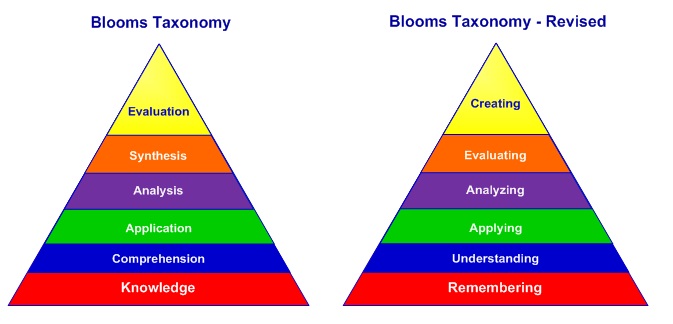
Bloom’s Taxonomy of Learning Domains was created in 1956 by psychologist Dr. Benjamin Bloom. This tool was created to outline the most proficient ways of thinking and obtaining knowledge and was intended for educators to use this method when designing learning processes. The organization of the six forms of learning is placed from lower order thinking skills to higher order thinking skills. In the most recent form of Bloom’s Taxonomy, the domains are as follows: remembering, understanding, applying, analyzing, evaluating, and creating. Remembering being the lowest order and creating being the highest.

It wasn’t until 2001 when a revised form was published from Lorin Anderson, a former student of Bloom, and David Krathwohl. The most prominent changes were writing the domains as verbs instead of nouns, as well as “creating” and “evaluating” being reversed. This new taxonomy is one that better illustrates the learning process. A very effective way to use Bloom’s Taxonomy in the classroom is when creating learning objectives for the students. Almost every lesson has a goal for the students to reach, and implementing critical thinking and steps to reach the goal, can have a positive impact on learning.


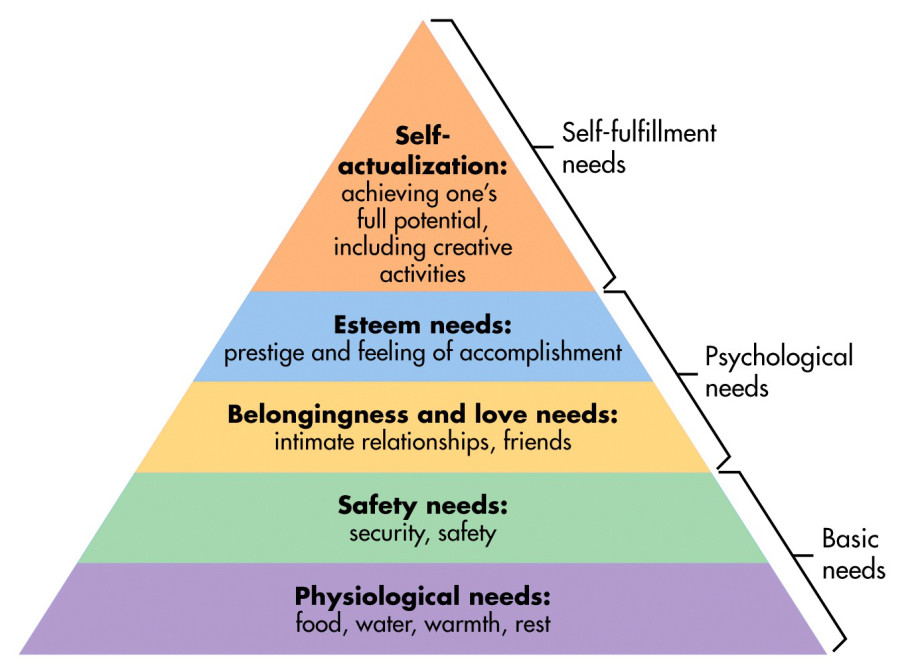
Maslow’s Hierarchy of Needs started out as a five-stage model that outlines exactly that, the most motivational needs of a human that initiate their behaviors. Abraham Maslow introduced this theory in his 1943 paper “A Theory of Human Motivation”. This hierarchy depicts five needs which are (from bottom to top) psychological, safety, belongingness and love, esteem, and self-actualization.

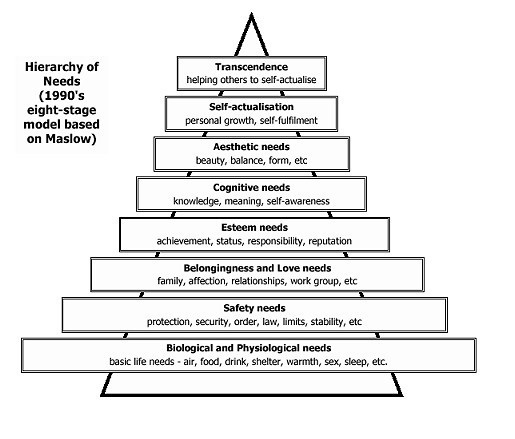
In the 1990s, Maslow revised his original five-stage model to now include 8 needs which included cognitive, aesthetic, and transcendence needs. The first four needs from the bottom where called the basic or deficiency needs. Maslow gave them this name due to the fact that if a person was ever deficient of these needs, it would motivate that person to satisfy the needs. The upper four needs are known as the higher-order needs, growth needs, or as Maslow called them, the “being” needs. These were labeled “being” needs by Maslow because he believed that by fulfilling them, you were being the most you could be.

I read a story someone published online about a time Maslow’s Hierarchy was in action. In simpler terms, he was at a store and asked someone to help him find an item. As the man was leading him to the aisle, he took a sharp turn to the bathroom out of nowhere. The publisher of the story said he thought back to this hierarchy of needs and remembers that one will try to satisfy their lower needs before they move towards the higher ones. In this case, the employee needed to fulfill his biological needs before he could move up towards transcendence of helping others.

https://www.amnavigator.com/blog/2009/03/14/maslows-hierarchy-of-needs-real-life-illustration/

Module One Readings Reaction

This week, we were assigned to read about 4 authors and their theories about technology and knowledge. In my reaction to these theories, I was to follow a guideline, so I included it for easier following. 

  • A brief biography of each author
  • Description of each theory in your own words
  • Similarities and differences between the theories
  • Aspects of these theories you found surprising and/or interesting

The first author I read about was Gordon Moore. As the co-founder of Intel Corporation, an American multinational technology company, Moore has built his career on his knowledge of computers and how they work. This knowledge he had would lead him to predict how computer speed and efficiency would advance in the future, which would later become “Moore’s Law”. His prediction that computer speed would increase at the same time as the relative cost would decrease, is still being discussed and debated 50 years later. There have been arguments against Moore’s Law, claiming that his theory has no more credibility in today’s age, due to the fact that computer size and functionality cannot grow forever. However, Moore’s initial prediction has paved the way for many advancements in the technology world. 

Second, I read about Richard Buckminster Fuller, an American architect who wanted to improve society as much as possible with inventions that were cheap and easy to mass produce that would limit negative impacts on the environment. Similar to Moore’s idea that computer processing would exponentially grow with time, Fuller had the same thoughts, but with human knowledge. Known as the Knowledge Doubling Curve, Fuller first noticed that by 1900, knowledge had doubled every 100 years. By the 1940’s he observed that it was doubling at the speed of every 25 years. As of today, with the research done by Fuller, it is predicted that with the assistance of the internet, the doubling of knowledge could happen every 12 hours.

 Ray Kurzweil is an American inventor, responsible for innovative technologies such as text-to-speech synthesis, voice recognition software and electronic keyboard instruments.  Kurzweil believes well into the idea that technology is forever changing. Kurzweil’s “Law of Accelerating Returns” which is based on how much change in different systems is increasing at an exponential rate. In 2001, Kurzweil wrote something along the lines of the amount of change the world will see in the 21st century. Unlike 100 years of progress previously seen, this century will likely see 20,000 years of progress. The predictions made by Kurzweil using his law, speaks loudly to the impact technology has on the progress of the world and how fast humans as a species are evolving using such technology.

Lastly, I read about Peter Theil, a billionaire who co-founded PayPal and is a board member on the popular social media Facebook. On the opposite end of what Moore and Fuller believed, Theil’s “The End of the Future” theory revolves around how technology innovation is now slowing, and people are spending their time and money in the wrong areas and should be working on solving “more important issues”. In doing so, he believes this will continue the technological growth that has recently stopped.

   I think the main component that ties these four authors together, is their outlooks on the advancement and growth of technology and knowledge. Each theorist had a belief of what the possibility of technology could be in the future. However, apart from the others, Theil’s look on the subject wasn’t exactly in the same place, where he thinks work needs to be done to continue an increase in the power of tech.

Throughout my time reading about these theories, it really made me think just how much technology has grown from the first printing press that changed the world forever. In such little time, we have gone from phones the size of one’s head, to phones that can fit your back pocket. I think the work Gordon Moore has done for the future of computing is extremely compelling, and never hearing about him and what he accomplished, really makes me admire all of the work these intelligent people have done for the future of our society.    
About Me

Welcome! My name is Emma Green and I am currently a sophomore attending the Unversity of South Florida. I am majoring in Elementary Education, and have had the dream of becoming a teacher for as long as I can remember. I aim to make a difference in students lives the same way I remember my fifth-grade teacher Mrs. B did for me. This blog is intended as a notebook for my class EME 2040, Tech for Leading and Learning. You will see many of my assignments and notes about the exciting material covering technology for educators I will learn over the course of this semester.