Bloom’s Taxonomy of Learning Domains was created in 1956 by psychologist Dr. Benjamin Bloom. This tool was created to outline the most proficient ways of thinking and obtaining knowledge and was intended for educators to use this method when designing learning processes. The organization of the six forms of learning is placed from lower order thinking skills to higher order thinking skills. In the most recent form of Bloom’s Taxonomy, the domains are as follows: remembering, understanding, applying, analyzing, evaluating, and creating. Remembering being the lowest order and creating being the highest.
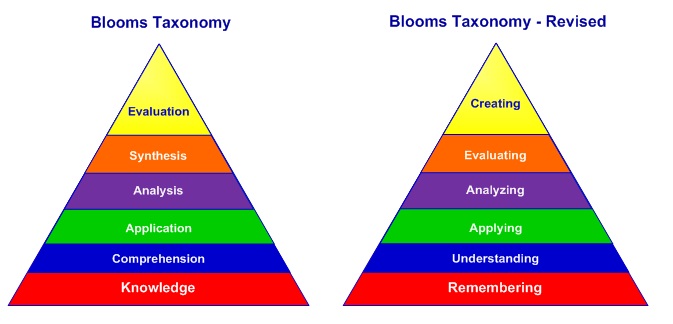
It wasn’t until 2001 when a revised form was published from Lorin Anderson, a former student of Bloom, and David Krathwohl. The most prominent changes were writing the domains as verbs instead of nouns, as well as “creating” and “evaluating” being reversed. This new taxonomy is one that better illustrates the learning process. A very effective way to use Bloom’s Taxonomy in the classroom is when creating learning objectives for the students. Almost every lesson has a goal for the students to reach, and implementing critical thinking and steps to reach the goal, can have a positive impact on learning.
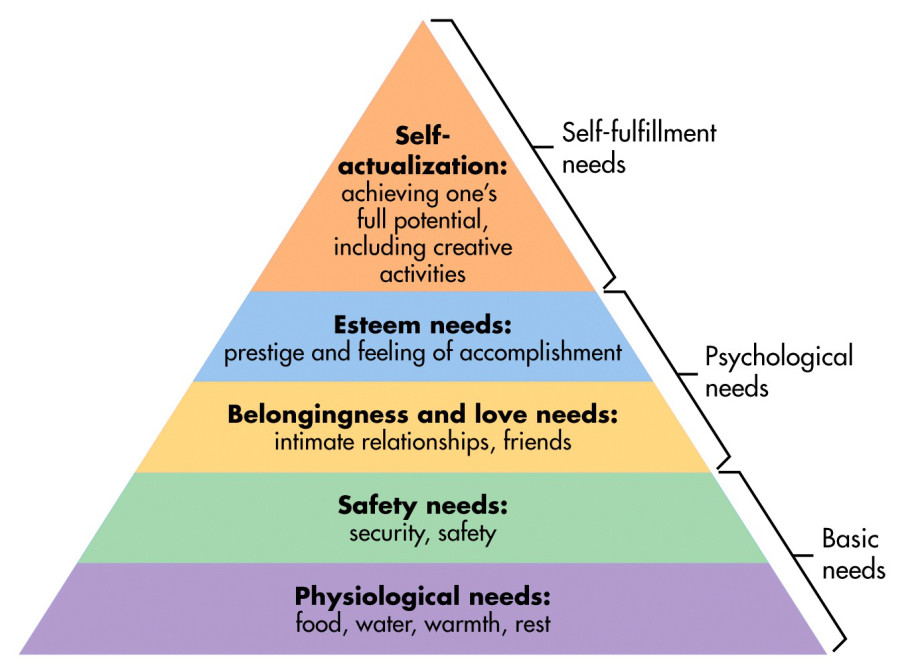
Maslow’s Hierarchy of Needs started out as a five-stage model that outlines exactly that, the most motivational needs of a human that initiate their behaviors. Abraham Maslow introduced this theory in his 1943 paper “A Theory of Human Motivation”. This hierarchy depicts five needs which are (from bottom to top) psychological, safety, belongingness and love, esteem, and self-actualization.
In the 1990s, Maslow revised his original five-stage model to now include 8 needs which included cognitive, aesthetic, and transcendence needs. The first four needs from the bottom where called the basic or deficiency needs. Maslow gave them this name due to the fact that if a person was ever deficient of these needs, it would motivate that person to satisfy the needs. The upper four needs are known as the higher-order needs, growth needs, or as Maslow called them, the “being” needs. These were labeled “being” needs by Maslow because he believed that by fulfilling them, you were being the most you could be.
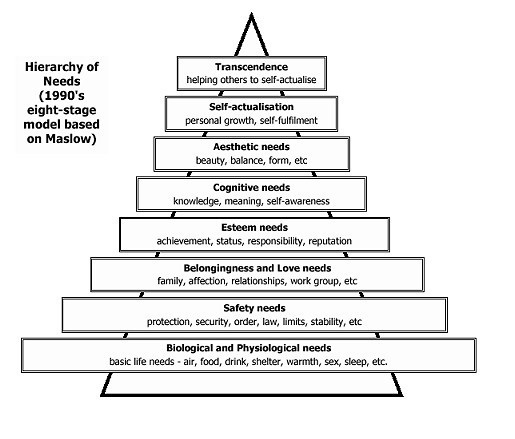
I read a story someone published online about a time Maslow’s Hierarchy was in action. In simpler terms, he was at a store and asked someone to help him find an item. As the man was leading him to the aisle, he took a sharp turn to the bathroom out of nowhere. The publisher of the story said he thought back to this hierarchy of needs and remembers that one will try to satisfy their lower needs before they move towards the higher ones. In this case, the employee needed to fulfill his biological needs before he could move up towards transcendence of helping others.
https://www.amnavigator.com/blog/2009/03/14/maslows-hierarchy-of-needs-real-life-illustration/
 Emma's Corner